Commentary: S$5 tank tops can end up costing too much
SINGAPORE: I can't remember the concluding fourth dimension I walked into a brick-and-mortar fast style retail store.
And no, it'southward not because the pandemic has made me wary of unnecessary contact with people. Neither is it because I've picked up an online shopping habit instead.
It's because I've more or less given up on fast fashion.
I used to love it. I spent my early on teenage years shopping regularly at H&1000, noticing that every other calendar week, when I returned, the unabridged store's inventory had changed, like magic.
I remember going upward and down the escalators at Somerset 313's Forever 21 with friends, spending fourth dimension in the changing rooms of Cotton On, trying on outfits and snapping selfies in them.
Only I too remember the flimsy quality of those S$15 rompers, the sheer, see-through design of the Southward$5.99 tank tops, and the many times Southward$xiv.99 sandal straps broke … in public.
READ: Commentary: Shorts and slippers aren't sloppy – they're sensible attire for Singapore's weather
READ: Commentary: I tried shopping for new wearing apparel for Chinese New year's day. It went abysmally
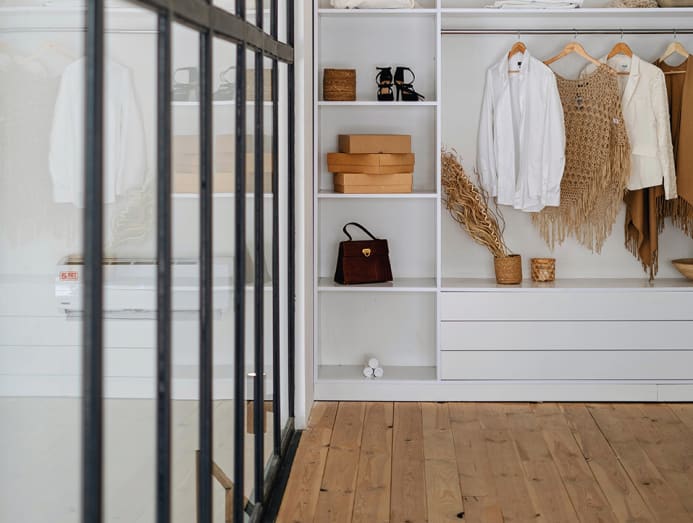
Today, my closet is made up of more than reliable items of wearable: Wearable, repeatable pieces from secondhand fashion accounts on Carousell or friends' closets, mixed in with fun and colourful vintage numbers from austerity shops, and the occasional splurge on upstanding fashion pieces.
I'm not proverb a higher toll tag equates to amend quality. And I however own pieces of fast fashion that accept lasted – I often reach for my thrifted pair of Zara pants, and my Cotton fiber On mock neck top remains a wardrobe staple, even after many years of wear.
Just we all the same should exist curious about the true cost of fast fashion.
THE TRUE COST OF FASHION
As well often, the companies who make these dress inexpensive don't make them well. The entire business model of fast fashion companies is congenital upon our ultra-fast consumption of wear: The more we buy, the more they make. Which means the faster we dispose of our clothing, the meliorate (for them).
So that frustration you feel when a cheap piece of wearable falls apart, and the sigh and shrug that accompanies yous going into the store to replace information technology? Information technology's entirely intended and works in their favour.
READ: The true toll of need for inexpensive dress, to you and the environment
Fast way grows its empire by making consumers feel similar they need to go on buying more, which explains the constant emails, countless sales and relentless collection drops.
These days, fast way brands get by "micro-seasons", producing much more than how they used to produce – that is, co-ordinate to the actual seasons. Hence, total clothing production has roughly doubled since 2000.
Such clothing may be affordable, just what is the cost we actually pay?
READ: Commentary: Post-obit a T-shirt from cotton wool field to landfill shows the truthful cost of fast fashion
Much has been written well-nigh the environmental cost of these cheap clothes, from cradle to grave. The fashion industry uses 79 trillion litres of water every year to produce cotton wool and other textiles, and produces 92 1000000 tonnes of waste material a year.
Information technology'southward responsible for 10 per cent of global carbon emissions – more than that of flights and maritime aircraft combined.
And it's non just destroying the planet. News report later on news written report detail examples of how the fashion industry is rife with exploitative practices and human rights abuses. Subconscious backside layers of sub-contracting are gruelling working hours, depression pay, lack of task security, dangerous (and fatal) working weather and suppression of merchandise unions.
READ: Can fast-fashion'due south US$two.v trillion supply chain be stitched back together?
OUR CLOTHES HAVE STORIES
But what happens to us when we purchase disposable fashion? The inconvenience of it all is one thing, but buy-and-throw-away culture has undeniably changed the way we engage with our clothing.
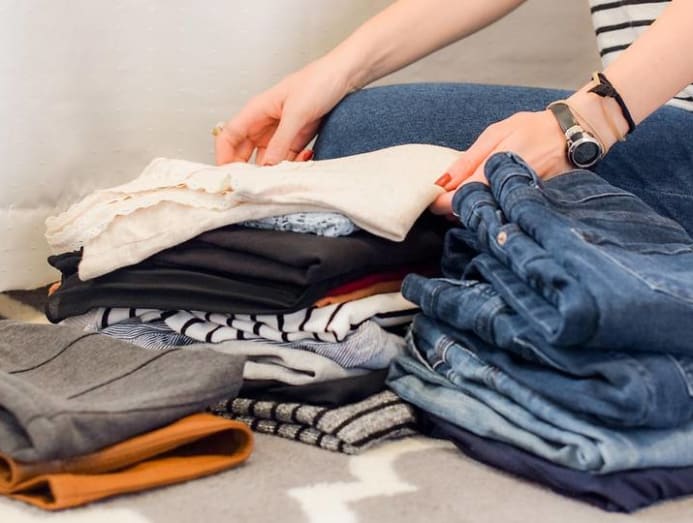
As we purchase more and more clothes, these items become utilitarian – we buy them solely to complete our outfits, hunt afterward trends and feel the rush of owning something new.
Merely clothes tin can accept stories, and nosotros can have relationships with the clothes we own.
Earlier this twelvemonth, I was invited to a private, pandemic-safe apparel swap past a friend. There were six of us, and each of u.s. brought items that we had loved, but were ready to part with.
The swap started with us going through each of our items in a testify-and-tell format. Nosotros recounted where we bought them, the places they had been with the states, the points of our lives during which they were featured the most.
Lookout man: Swop, don't shop: Upcycling and recycling in preparation for Chinese New year | Video
That mean solar day, after giving abroad a number of mine, I adopted a pair of black polyester pajama pants with Chinese characters printed on them, an oversized pinkish and brown loose-knit blouse, a pair of dark denim Armani jeans and a Boy Scouts of America compatible shirt.
Each of them, I imagined, had their own stories beyond the stories that were told that 24-hour interval. Just more than the acquisition of those pieces themselves, I felt like I'd taken pieces of those who owned them.
It hit me then that I couldn't recall the final time I felt continued to the items of wear I endemic. I had a wardrobe full of stuff, but the stuff had no meaning across their commonsensical role.
READ: Commentary: Five pandemic lessons nosotros have learnt that should tide the states over any surge in cases
RETHINK, Irksome DOWN AND ASK QUESTIONS
Rather than Marie Kondo our apparel away and down-size our wardrobes, perhaps the solution to regaining that zipper to our wearing apparel is to rethink how we consume them, and and so ho-hum down.
To get-go, we tin can go more than intentional about our purchases.

This doesn't hateful we have to purchase more expensive, upstanding mode. I've found thrifting to be much more of a thrilling experience than regular shopping.
Thrifting runs the gamut of charity shops, secondhand shops tucked abroad in placidity malls or unsuspecting buildings and even popular-up events. Cheque out New2U (a classic), The Manner Pulpit (for more comfortable try-ons) or Five Finds Thrift Market (packed with Gen-Z styles).
In that location are hidden gems everywhere, you never know what you'll find, and you'll never look the same as someone else.
Organising a wearing apparel swap among your friends or community also achieves the aforementioned event, and is not as logistically complex every bit you might think.
READ: Commentary: Secondhand clothing sales are booming – and could be the reply to style'due south sustainability crisis
READ: Commentary: Missing the thrill of dressing up for work as a man
Practicing improve intendance for the dress we currently own is a way to kickoff too. If not picking upwardly repairing skills yourself (ever heard of visible mending or upcycling?), try visiting the many tailoring shops we have on the island and supporting a dying trade, instead of but ownership something new.
Private consumers non consuming fast fashion lonely is not going to exist sufficient. Unplugging the fast style auto requires shedding light on the unethical practices of fast manner companies, working with governments and international bodies to enact legislation to protect garment workers and our environs, which mode activists are doing.
Merely activists need our help besides: To set higher standards for our personal wardrobes (if we tin can), and beyond that, to ask more questions. To be more curious nigh what's backside the label.
We don't take to feel guilty that we can't command the decisions fabricated by fast fashion companies – but we can force per unit area them to make amend, and brand less.
If private actions won't motion the needle on climate change, what will? Discover out what climate activists are pushing for on The Climate Conversations:
Tammy Gan is a social media activist and freelance writer focused on getting people to think deeper about ecology and social justice problems, in service of more merely futures.
Source: https://cnalifestyle.channelnewsasia.com/commentary/fast-fashion-clothes-sustainability-worker-climate-change-thrift-240476
0 Response to "Commentary: S$5 tank tops can end up costing too much"
Post a Comment