SEAMAAC feeds thousands—and gets out the vote—during Covid-19
Sep. 02, 2020


Throughout the spring, as thousands of people every day received meals and boxes of food from SEAMAAC, the Due south Philly-based nonprofit that since 1984 has served immigrants and those in need, they were apt to find not simply a variety of healthy and delicious foods.
 Forth with the veggies and tofu and burritos, each box likewise included pamphlets for the census, and nonpartisan data about voter registration and absentee ballots. This wasn't every bit divergent as information technology might seem. In fact, it'south all part of SEAMAAC's larger mission, to improve serve its constituents by helping them ameliorate engage with their city.
To SEAMAAC Executive Managing director Thoai Nguyen (pictured to a higher place), civics and nutrient naturally overlap: Food insecurity, he says, is a social justice issue. Voting and the census is role of that. And the message worked: Nguyen's team had a 100-percent success charge per unit with their turf, meaning everyone they encountered returned their census.
And whereas the national average for "getting out the vote" work is 25 to thirty percent, lxx-plus pct of the voters SEAMAAC reaches via phone, text, and door-knocking (before Covid) actually cast a ballot on Election Day.
"Nosotros know these families, we do case management with them, we've seen these young people, nosotros've known them for years and years and years, then nosotros know their habitation condition," Nguyen says. "And for us to say, you know what, everybody's closed downwardly, and then we might as well close downwards? That'southward unacceptable."
"While the coronavirus pandemic has tested the limits of our fidelity to [our] mission, nosotros take responded by refocusing much of our resource to support those virtually affected by the pandemic—the poor, working grade, people of color, immigrants and women and children," Nguyen says. "Our mission is actually about allowing marginalized communities to live in the U.South. with joy and dignity. But you lot can't just hope for things to happen—you have to work at it."
Rise to the Challenge in Pandemic Times
SEAMAAC was in the midst of its census and voter data push in March, when the pandemic hit Philly and social services organizations all over boondocks faced an unprecedented amount of need—with an unprecedented amount of doubt nearly how to meet it.
This was no less true for SEAMAAC. In that location were the staff challenges—how do you serve the community when, for safety reasons, you can't take your whole staff gathering in-person?
There was the complex logistics of getting food to hungry Philadelphians: What nutrient-relief partner could they count on when so many are competing for resource? How could they get the city to support their efforts?
And there was the overriding business organisation about non abandoning their existing work: How could they pivot and even so provide for the 300 refugee elders they back up, and the women and children in their domestic violence programs and family shelters? How could they proceed pushing their voter registration, census and other civic appointment efforts?
That SEAMAAC has been able to rise to the challenge is a reflection of the organisation's foresight, its relationship-edifice and Nguyen's say-yes mentality.
"I'one thousand a man of science, so even a calendar month before Governor Wolf declared a pandemic, we were scaling downward," Nguyen says. Not getting the resources they needed from Philabundance, they instead paired upwardly with Share Food Program. They connected with the Office of Children and Families, led by Cynthia Figueroa, and the Office of Homeless Services, led past Liz Hersh.
They kept a core staff of just five people, including Nguyen, reporting to work, but kept their staff, who speak 22 languages, available by phone for the community; they partnered with Broad Street Ministry and expanded to distribute from their own HQ as well equally South Philly Barbacoa and Key School.
Far-Reaching Touch on
Since March 27, SEAMAAC has addressed more than 150,000 instances of hunger, distributing more than 1,000 meals and food boxes a day since mid-May.
They also partnered with Philly FIGHT to do more than 400 gratuitous Covid tests. They have an art display by elders. They've continued to offer their signature youth program, Hip Hop Heritage, to 50 families, and have distributed fine art kits to all of them.
In March they launched an initiative to support small businesses in Due south Philly—to date they have helped bring almost $500,000 of funds to pocket-sized family unit- and immigrant-owned businesses in South Philadelphia, including the purchase of meals for the Step Upwards to the Plate Program, SEAMAAC'south souvenir certificate programme, and support to help these businesses receive diverse Covid-19 small business relief funding.
"I've been hearing a lot of people proverb, 'We're all in this together,' and I'thousand sorry, only we're non," Nguyen says. "At that place are people that are hoarding, there are people that have basically close their doors. Correct now we're not all in this together—merely we should be."
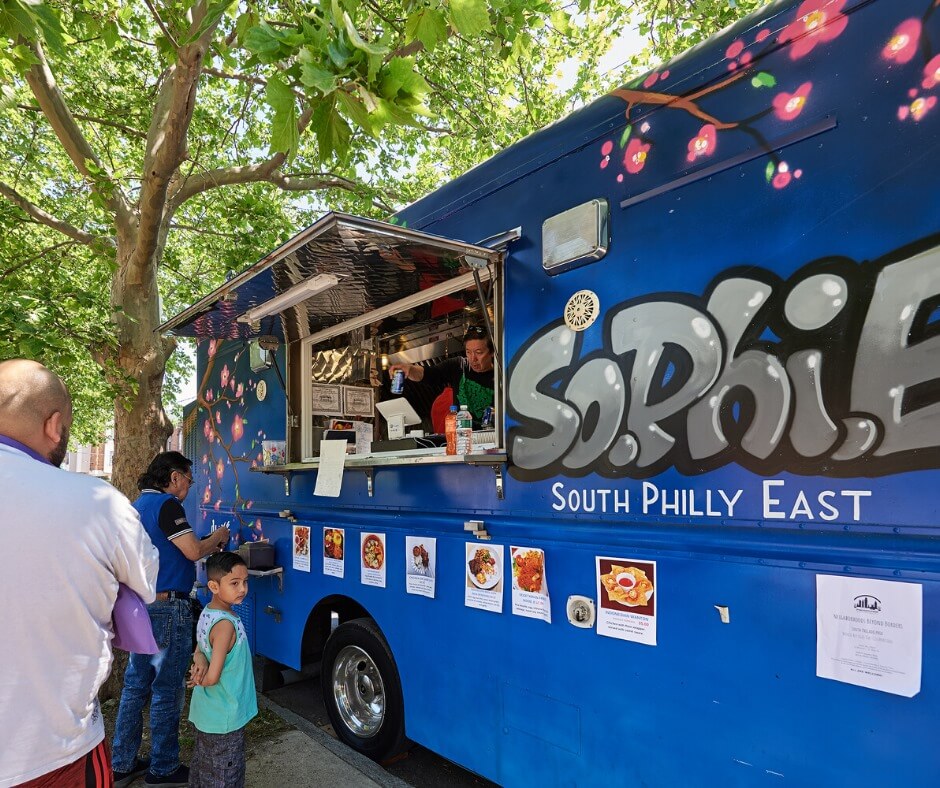
Their SoPhiE (or South Philly East) Food Truck is a "Business organization Incubator" plan, wherein SEAMAAC trains and helps to certify entrepreneurs who want to start a business merely have no capital. "SoPhiE allows the nutrient truck to be used for free by qualified and interested entrepreneurs without whatsoever investment of capital," Nguyen explains.
To date, they've hosted xiii chef-entrepreneurs and four have gone on to have their own successful businesses in the food and catering industry in Philadelphia.
"A lot of folks think that SEAMAAC only helps the Asian customs, but they help and so many people," says Steve Preston, chief programme officeholder at Share Food Plan, which partners with SEAMAAC on the food distribution. "When y'all go through their line, you see how various it is, and that really speaks to the reach that SEAMAAC has. They're getting out at that place and helping every single community, regardless of who they are."
The Roots
The history of SEAMAAC goes back to the early '80s, when five organizations serving the influx of immigrants from Southeast Asia banded together to pool resources. They provided essential services to people coming from state of war-torn Asian nations, from financial assistance to literacy programs.
And then came a wave of immigrants from elsewhere around the globe: Yugoslavia and West Africa, South and Central America.
Nguyen, whose offset proper name is pronounced "Toy," came with his family to South Philly from Vietnam in 1975, when he was ix. Equally an adult, he spent well-nigh two decades working as a community organizer throughout the U.Southward. and in Africa, Asia, and many countries in Eastern, Central, and Western Europe, but he considers Philadelphia his habitation. And when he took the reins at SEAMAAC, he was determined to brand this city feel like home for people of all backgrounds.
"Philadelphia is known as a city of neighborhoods, merely actually we're a city of tribes, and sometimes those tribes don't really get along," he says.
The perennial disharmonism was a mystery for Nguyen. "That's the beautiful thing about the city of Philadelphia, the potential to celebrate multifariousness. I wanted to formally permit SEAMAAC to recognize Eastern Europeans, Africans and Latinx folks as part of our community—non just tangential to our mission, but integral."
The shift to comprehend cultures began with SEAMAAC'southward after-school programs.
I afternoon early in his tenure, Nguyen visited the after-school programme, which at the fourth dimension exclusively served Asian children and was run exclusively past Asian staff, except for one Liberian staff member. "I saw a young, Vietnamese student come in with his Black friend, an African-American student, and when they entered, our staff basically said, 'You know, we welcome y'all, but we actually don't serve yous,' to the Blackness kid. And I just felt that was totally wrong on so many levels, that I sought to modify things across the organization."
He immediately opened the doors to anyone who wanted service through SEAMAAC. In doing so, he also opened the door for more than diverse staffing. "A lot of our mission here at SEAMAAC is, when we serve diverse communities, we desire our staff, our people, to exist authentic, to take an authentic understanding of each of the communities we serve," he says.
 By the summer of 2007, he introduced a summertime program centered effectually his beloved hip-hop, offer DJ-ing, breakdancing, graffiti fine art, jazz and spoken-word poetry. Skeptics questioned the merits of hip-hop as an art course or educational vehicle. But Nguyen's instincts were right: "That summer, we were mobbed with the almost diverse group of families we had always seen," he says. SEAMAAC formerly stood for "Southeast Asian Mutual Assistance Associations Coalition, Inc."; but with their expanded mission, vision and telescopic of services to serve but about everyone, that no longer made sense—they now only refer to themselves equally SEAMAAC, Inc.
Now, SEAMAAC is on twelvemonth 13 of their continually popular Hip Hop Heritage program; at its height, information technology served 350 kids, despite receiving payment from only a fraction of them. "We won't plough anyone away," Nguyen insists.
He hires high-quality education artists, and pays them 50 percent over market-rate for other after school programs. "When you dearest people and you respect them for what they do, their creative process, y'all get that stuff back," he says of the investment his artists cascade dorsum into the plan.
They've been able to cover the costs of programming because they were both, as Nguyen says, "in a great financial position when the country went into quarantine in March 2020," and received an infusion of funds from longtime supporters and foundations, including their own fundraising campaign to support refugee elders and vulnerable families.
At least one City department allowed them to repurpose some funds towards staffing for the hunger relief efforts for the months of April through June, but that stopped every bit of July 1. Since the start of the pandemic, SEAMAAC has non laid off any staff—instead, they accept added more than xv total-time staff to their team, with full health benefits immediately accessible on their first day of work.
And now the staff, which had for and so long been predominantly Asian, is more than than 55-percent African-American or people of African descent. The system serves Burmese, Butanese and Nepali refugees; staff speak those languages, and over 20 others.
Under Nguyen's leadership, SEAMAAC has grown to include not only the summer hip-hop programs, but a robust roster of wellness services, ESL and literacy support, domestic violence services and more.
Every bit Covid-xix struck the SEAMAAC customs, Nguyen and his team rose to the claiming with the aforementioned approach they brought to Hip Hop Heritage back in 2007: creatively, holistically, and with open arms.
"These Are Heroes"
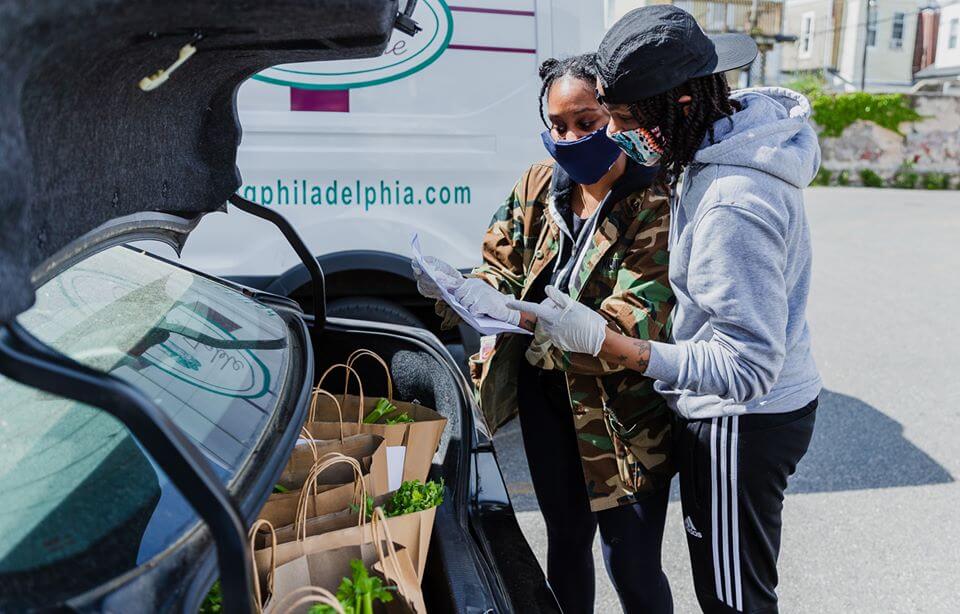
The people behind the scenes, Nguyen says, enabled SEAMAAC to be the just South Philly nonprofit that started and has continued operating throughout the unabridged pandemic. "These are heroes," Nguyen, who doesn't throw the word "hero" around lightly, says.
"If yous know that these families accept a need and yous do null near it, it'south unconscionable," Nguyen says. "We know these families, nosotros exercise example direction with them, we've seen these young people, we've known them for years and years and years, so we know their habitation condition. And for us to say, you lot know what, everybody's closed downwardly, so we might besides close down? That's unacceptable."
 Every bit we approach the sixth month of the pandemic, Nguyen says that a few partners that have been collaborating with them are scaling downwardly their operations, or stopping altogether—only SEAMAAC is scaling upwards. "We project that the impact of the pandemic on marginalized communities volition be protracted and will affect their health and livelihood for many years," he says.
Greg Hammond, a Philly native, heard near SEAMAAC'southward food distribution through a friend. Prior to the pandemic, he'd never received nutrient from an organization, only since late March he'due south been going every 24-hour interval for lunches, and on Mondays, Tuesdays and Thursdays for boxed food offerings, to get provisions for himself and his 79-year-erstwhile female parent.
As of import, he adds, is that the food is adept. "It's been very various, from pasta and chicken to tofu and burritos and various ethnic foods. My mother eats it all without complaint."
Hammond says that SEAMAAC has taken the tragedy of the current assistants's failure to adequately accost the pandemic and turned it into an opportunity for the community to come up together.
"Nearly people who get to a food banking company sort of experience ashamed. And nevertheless Thoai's staff is very polite, they're very bubbly, they're very friendly. There'due south no shame about annihilation," he says. "I'm African-American and I've lived in unlike countries for college and grad school, and I really enjoy the multifariousness of the staff and the community that SEAMAAC serves. People speak Cambodian and Vietnamese and French, and anybody is then friendly."
That same spirit doesn't always come across in return, unfortunately. Nguyen says one of the most disappointing aspects of SEAMAAC's hunger-relief efforts have been the consequent anti-Asian sentiments his team faces during the course of their piece of work to feed people.
 "The assailants are primarily white people in line to receive food, while many of our volunteers are Caucasian, and a meaning number of our staff and leadership are Asian=American, and [at that place's a] cognitive dissonance that happens when white folks in the food line or equally passersby verbally assail Asian staff and volunteers during our efforts," he says.
Since March, he has personally had to face up people during 3 separate incidents of hate speech communication. What he asks of Philly is for people to finish being afraid of alter.
"I've been hearing a lot of people saying, 'We're all in this together,' and I'm sad, I beg your pardon, only we're not. There are people that are hoarding, there are people that have basically close their doors. Right at present we're not all in this together—merely we should be."
Header photo: SEAMAAC Executive Director Thoai Nguyen hands out nutrient at City Hall during Covid-nineteen 
Source: https://thephiladelphiacitizen.org/seamaac-philadelphia/
0 Response to "SEAMAAC feeds thousands—and gets out the vote—during Covid-19"
Post a Comment